You can’t just start shouting your brand’s name from the rooftops and expect people to care. Before you design a single foam finger or schedule a single social post, you have to lay the groundwork.
This is the part everyone wants to skip, but it’s the most important. It’s where you figure out what to say, who you’re saying it to, and why they should listen. Without this, you’re just making noise.
Building Your Brand Awareness Foundation
Too many businesses jump straight into tactics—running ads, sponsoring events, you name it. This almost always leads to a jumbled message that falls flat.
The goal here is to build a brand that feels real, consistent, and memorable from the moment someone first hears about you. This is your strategic blueprint. Get it right, and every dollar you spend on marketing will work harder.
This early work boils down to a few core components that you absolutely cannot skip. They inform every single decision you'll make later on.
Before we dive into the details, here's a quick look at the foundational pillars of any solid brand awareness strategy.
| Core Components of a Brand Awareness Strategy | ||
|---|---|---|
| Component | Objective | Key Actions |
| Brand Identity | To define who you are, what you stand for, and how you communicate. | – Solidify mission and vision. – Establish non-negotiable core values. – Define a consistent brand voice and personality. |
| Audience Research | To go beyond demographics and truly understand the people you want to reach. | – Conduct surveys and interviews. – Analyze social media conversations. – Create detailed customer personas. |
| Goal Setting | To define what success looks like with specific, measurable targets. | – Establish SMART goals. – Identify key performance indicators (KPIs). – Align goals with specific channels and tactics. |
With this framework in mind, you're not just throwing things at the wall to see what sticks; you're building a brand with intention and purpose.
What’s Your Brand's DNA?
Your brand identity is way more than a slick logo. It’s the soul of your company. It’s the answer to the big question: "Who are we, really?"
Start with your mission and vision. Why do you exist beyond making money? What dent are you trying to put in the universe?
Then, nail down your core values. These are the principles that guide every single thing you do. Think of them as your brand’s conscience. If "sustainability" is a core value, it should show up in your products, your packaging, and your partnerships.
Finally, figure out your brand's voice. Are you the witty, clever friend or the trusted, authoritative expert? That voice needs to sound the same everywhere—on your website, in your emails, and in your social media replies.
Who Are You Actually Talking To?
You can’t build awareness if you don’t know who you're trying to make aware of you. Basic demographics like age and location are just table stakes. You need to get into their heads.
What do they care about? What keeps them up at night? What makes them tick?
- Talk to them. Run surveys and interviews with your best customers (and the ones you wish you had). Ask them about their biggest challenges and what they really want from a brand like yours.
- Listen online. Use social listening tools to see what your audience is talking about. What content do they love? Who do they follow? This is free, unfiltered insight.
- Build personas. Go beyond a simple profile. Give your ideal customer a name, a job, and a story. When you’re creating for "Sarah the busy project manager" instead of "females 30-45," your message will hit a lot harder.
At the end of the day, this is all about building trust. Awareness without trust is just noise. The numbers don't lie: 81% of consumers need to trust a brand before buying from them, and they are 50% more likely to purchase from recognized names. This is why being a good corporate citizen matters—a solid 55% of consumers will pay more for products from socially committed brands. You can dig into more of the critical brand awareness statistics that prove why this foundation is so vital.
Define What a "Win" Looks Like
The last piece of the puzzle is setting clear, measurable goals. "Get our name out there" isn't a goal; it's a wish. You need SMART objectives (Specific, Measurable, Achievable, Relevant, and Time-bound) to know if you're actually getting anywhere.
Your goals will steer your entire playbook. For example:
- Goal: Boost our social media footprint.
- How you'll measure it: Track follower growth, engagement rates, and how often you’re mentioned versus the competition (share of voice).
- Goal: Get more people to our website directly.
- How you'll measure it: Keep an eye on the "Direct" traffic source in your Google Analytics. When people type your URL straight into their browser, it’s a killer sign of brand recall.
- Goal: Become a go-to expert in our industry.
- How you'll measure it: Count the number of press mentions, guest articles you land, or shout-outs from key influencers.
This foundational work is what separates brands that make a temporary splash from those that build a legacy.
Crafting a Message That Resonates
Alright, you've got your strategy locked down. Now for the fun part: giving your brand a voice and a face. This is where you move from spreadsheets to storytelling, creating the words and visuals that make people actually feel something about your brand.
It’s about building a genuine personality that your audience wants to connect with. A killer message isn’t just about clever taglines; it's a reflection of your company's soul. And a strong visual identity? It’s more than just a pretty logo—it’s how you get recognized in a split second.
These are the creative tools that turn a one-time customer into a loyal fan.
Finding Your Unmistakable Brand Voice
Your brand voice is the distinct personality that shows up in every tweet, email, and blog post. Is your brand the funny one? The wise expert? The supportive friend? Whatever you choose, the key is consistency. A user who loves your witty Instagram caption shouldn't be met with a corporate robot on your website.
Think of it like a person. If your super-serious, data-obsessed friend suddenly started telling corny jokes 24/7, you’d be confused. It feels off. The same goes for your brand.
To nail down your voice, go back to those audience personas you built. What kind of tone would they actually respond to?
- Witty and Playful: Perfect for brands that want to connect with a younger crowd that values authenticity. Wendy's legendary Twitter account is the gold standard here.
- Authoritative and Educational: A must for B2B companies or anyone in a complex field where trust is everything. Think of a financial advisor who gives you clear, straight-to-the-point advice.
- Empathetic and Supportive: Ideal for brands in wellness, healthcare, or nonprofits. The goal is to build a deep, emotional connection that shows you genuinely care.
Once you’ve figured it out, write it down. A simple style guide with "do this, not that" examples will keep your entire team singing from the same hymn sheet.
Building a Recognizable Visual Identity
If your voice gives your brand its personality, your visual identity gives it a face. People process images way faster than text, which makes your visuals critical for instant recognition. A strong visual system ensures your brand is unmistakable, whether it's on a social media ad, a billboard, or even a custom foam finger.
This goes way beyond your logo. It's the entire toolkit you use to create a consistent look and feel everywhere your brand shows up.
Your brand assets—logos, color schemes, slogans, and fonts—are what stick in people's memories. When you trigger emotions through your messaging and reinforce them with consistent visuals, you build powerful brand associations that last.
Here are the non-negotiables for a solid visual identity system:
- Logo: This is the cornerstone. Keep it simple, memorable, and flexible enough to look good big or small.
- Color Palette: Pick a set of primary and secondary colors that match your brand’s personality. For example, blues often feel trustworthy and stable, while a pop of yellow can bring energy and optimism.
- Typography: Choose a couple of go-to fonts for headlines, body text, and callouts. It's a small detail that makes a huge difference in looking polished and professional.
- Imagery Style: Decide what your photos and graphics will look like. Are you going for bright, user-generated-style shots or sleek, professional studio photos? A consistent style tells a consistent story.
These elements all work together to create a mental shortcut to your brand. Think about the instant recognition of Tiffany & Co.'s robin's-egg blue or Coca-Cola's classic script. That's the power of a cohesive visual identity in action, and it’s how you build awareness that actually sticks.
Finding and Owning Your Best Channels
You've got a killer message and some awesome creative. Now, where do you put it? Throwing your budget at every platform out there is like trying to shout in a crowded stadium—you’ll just get lost in the noise. The secret isn't being everywhere; it's being everywhere your ideal audience already is.
This is where you have to move past assumptions. Just because a platform is trending doesn’t mean it’s the right fit for your brand. A smart channel strategy makes sure your message actually lands, connecting with people when and where they’re ready to listen.
Mapping Your Channels to Your Audience
First things first, go back to those audience personas we talked about. Where do these people really spend their time, both online and off? Don't guess. Dig into the data to match your channels to their actual habits.
- Selling B2B SaaS to tech leaders? LinkedIn is your best friend for sharing deep-dive content. Back that up with some targeted PR in industry publications and sponsor a few niche tech podcasts. Suddenly, you're not just a vendor; you're an authority.
- Running a DTC fashion brand for Gen Z? Your playground is TikTok and Instagram Reels. Forget traditional ads and instead, team up with fashion micro-influencers. Run campaigns that get users to create and share their own content—it builds a loyal community way faster.
- Growing a local service business? Go hyper-local. Sponsor the town's fall festival, get active on Nextdoor, and run geo-targeted ads on Facebook. Want to become a local legend? Hand out custom foam fingers at the high school football games. Now you’re part of the town’s fabric.
The trick is to think exactly like your customer. Are they tuning into podcasts on their morning commute? Scrolling through Instagram before bed? Reading trade magazines to get an edge at work? Go meet them there.
Mastering Social Media for Brand Awareness
For most people, social media is the first place they’ll go to check out a brand. It’s your digital storefront, community bulletin board, and direct line to your customers, all rolled into one. But you can't just post and pray.
It’s a powerful tool because it puts you right where people are already hanging out. The numbers don't lie: 89% of marketers say they’ve gotten more exposure for their business thanks to social media. Better yet, 77% of consumers would rather buy from a brand they follow online. But it takes consistency—a person needs to see your brand 5 to 7 times before it really sticks. This effect gets a massive boost from partnerships, since a staggering 92% of people trust recommendations from their peers.
You can see more branding statistics that really drive home how important a solid social game is.
The key is to focus. Don’t get shiny object syndrome and jump on every new app. It's far better to be a big deal on one or two channels than to be a nobody on five of them.
Beyond the Feed: Strategic Partnerships and PR
While social media gives you direct access, PR and strategic partnerships build something different but just as crucial: credibility. When a respected publication features your brand or you team up with another cool company, it’s like getting a stamp of approval from a trusted friend.
Earned media coverage or a smart brand partnership is pure third-party validation. When someone else says you’re great, it carries so much more weight than when you say it yourself. This is how you build trust that scales.
Start by making a list of publications your audience actually reads and influencers they follow. Then, craft a compelling story—not a sales pitch. Talk about your mission, a customer’s success story, or an interesting piece of data you’ve uncovered.
When it comes to partnerships, find brands that share your values and talk to a similar crowd without being a direct competitor. A fitness apparel brand could team up with a healthy snack company for a joint giveaway, for example. It’s a win-win that introduces both brands to a fresh, relevant audience and creates positive vibes all around.
All the planning in the world doesn't create a single ounce of brand awareness. The real magic happens when your strategy hits the pavement. This is where your ideas become real campaigns that actually grab people's attention and start building connections.
Execution is all about closing that gap between a great idea and a real-world result. It’s the nitty-gritty of turning audience research, messaging, and channel plans into actual, coordinated activities. Let's look at two totally different scenarios to see how this comes to life.
The DTC Brand Guerrilla Marketing Playbook
Picture a new direct-to-consumer (DTC) beverage brand trying to make a name for itself in a crowded market. They’re going after millennials who care more about authentic experiences than slick ads. Instead of blowing their budget on generic digital ads, they decide to go all-in on a high-impact guerrilla marketing campaign at a huge local summer music festival.
The goal isn't just to give away free drinks; it's to create a moment people can't help but share.
Here’s how they could pull it off:
- Create an "Oasis": They set up a branded "chill zone" in a high-traffic spot. It’s got free cold drinks, phone charging stations, and comfy chairs—a total lifesaver in the festival heat.
- Fire Up the UGC Engine: The main attraction is a photo booth with a funky backdrop and props that match the brand’s fun vibe. They also hand out 1,000 custom foam fingers printed with a catchy, hashtag-ready slogan.
- Incentivize the Shares: To get their product into people's hands and onto their social feeds, they offer a free can to anyone who posts a photo from the booth or with a foam finger, as long as they tag the brand and use the festival hashtag.
This works because it creates instant buzz and a ton of authentic social proof. The budget is laser-focused, the timeline is tight (just one weekend), and success relies on energetic brand ambassadors who know how to engage the crowd.
This kind of campaign brilliantly activates multiple channels, starting with your own event, which then gets amplified on social media and hopefully even catches the eye of local press.
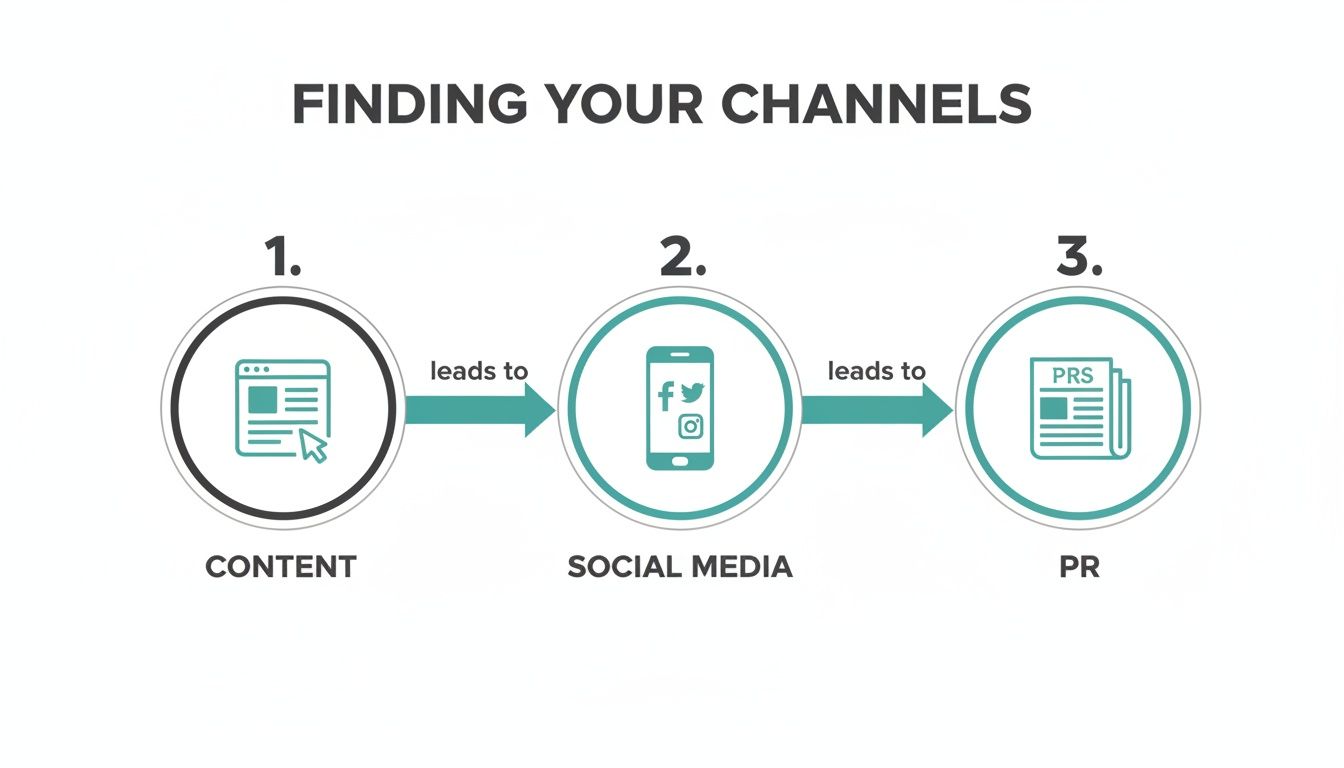
As you can see, a single, well-executed event can create ripples across different marketing channels, getting you way more bang for your buck.
The B2B SaaS Thought Leadership Campaign
Now, let's pivot to a B2B SaaS company trying to stand out in the packed project management software space. Their audience? CTOs and senior project managers who want data-driven insights, not flashy gimmicks. Their plan is to roll out a thought leadership campaign over an entire quarter.
The main goal is to become the trusted resource for industry trends, not just another software company trying to sell something. The whole campaign is built around one killer piece of content.
When you provide genuine value and insight, you build the kind of deep awareness and credibility that advertising can't buy. A well-executed thought leadership strategy positions your brand as a trusted advisor, not just a seller.
Here's a breakdown of their action plan:
- Create Cornerstone Content: They start by conducting an original research study on "The Future of Remote Project Management," surveying 500 industry leaders and packaging the findings into a seriously comprehensive report.
- Launch with a Webinar: The report isn't just dumped on their website. It’s launched with a live webinar featuring their Head of Product and a respected industry analyst. They promote this heavily on LinkedIn to reach their target audience.
- Amplify with Supporting Assets: They slice and dice the report's data into a series of data-rich LinkedIn articles, easily shareable infographics for social media, and guest posts for major industry blogs.
This campaign is so effective because it delivers genuine value and cements the brand's expertise. The budget is spent on quality research and targeted promotion, the timeline is spread across a full quarter to build momentum, and the entire team—from marketing to product experts—is aligned to deliver a consistent, authoritative message.
Measuring What Matters for Brand Growth
So you’ve run the campaigns, engaged the crowds, and handed out the foam fingers. Now for the big question: how do you know if any of it is actually working?
Proving the value of brand awareness can feel a little like trying to catch smoke, especially when you’re playing the long game instead of chasing immediate sales. The secret is to stop obsessing over vanity metrics, like follower counts, and start looking for signs of real, sustainable growth.
Measuring brand awareness isn’t just about justifying your budget. It’s about getting the intel you need to make smarter moves next time. When you track the right things, you can confidently double down on what’s working and tweak what isn't.
Moving Beyond Surface-Level Metrics
It’s easy to get distracted by numbers that look good on paper but don't tell the whole story. A viral post is great, but did it actually change how people see your brand? To get the real picture, you need to blend hard data with human feedback.
Here are a few metrics that actually show your brand is gaining traction:
-
Direct Website Traffic: This is the gold standard for brand recall. When someone types your URL directly into their browser, it means they remembered you without a prompt. A steady climb in direct traffic in Google Analytics is a powerful sign that you’re sticking in people's minds.
-
Branded Search Volume: This one’s simple: how many people are specifically searching for your brand name or products? Tools like Google Search Console show you this data, and an upward trend means more people are actively seeking you out—a direct result of your awareness efforts.
-
Social Media Share of Voice: This metric stacks you up against the competition. It answers the question, "Of all the conversations happening in our industry, what percentage are about us?" Social listening tools can track this, giving you a clear benchmark of your influence.
These numbers connect your efforts to real-world behavior. They prove people aren't just seeing your brand; they're actively looking for it.
Gathering Actionable Brand Insights
Numbers only tell half the story. To understand the why behind the data, you have to tap into how people actually feel about your brand. This qualitative feedback is where you'll find the game-changing insights.
And you don't need a massive budget to start gathering it.
A key goal of any awareness campaign is to build strong brand memories and emotional connections. Tracking how your audience feels and talks about you is just as important as tracking how often they see you. It's the difference between being known and being valued.
Consider weaving these methods into your measurement plan:
-
Brand Perception Surveys: These can be as easy as a one-question poll on your website or a short survey for your email list. Ask direct questions like, “What words come to mind when you think of our brand?” or “How likely are you to recommend us to a friend?”
-
Social Listening for Sentiment: Go beyond just counting mentions. Modern social listening tools can analyze the feeling behind the conversations. Are people talking about you positively, negatively, or just neutrally? This helps you gauge your brand's overall reputation.
-
Media Monitoring: Keep an eye on where and how your brand is mentioned by the press, bloggers, and influencers. Getting featured in a respected industry publication is a huge win for your authority and credibility.
Turning Measurement into a Growth Engine
Collecting data is one thing; using it is another. The real magic happens when you use those insights to sharpen your strategy. Regularly review your key performance indicators (KPIs) to spot trends and figure out what’s driving them.
Did your branded search volume spike right after you sponsored that local event? That’s a strong signal your event marketing is paying off. Did a particular series of educational blog posts lead to a jump in positive social media sentiment? That’s your cue to create more content just like it.
It's a continuous feedback loop: execute, measure, learn, and apply those learnings to make your next campaign even better.
One of the most established ways to build awareness is through smart advertising. Global ad spending hit $641 billion in 2019, and the impact is clear—brands that put 10-35% of their equity into marketing see major returns. For growing brands, this often means starting with targeted digital ads, especially on mobile, which grabbed 68.2% of digital ad spend that same year. You can explore more about brand awareness statistics to understand the power of strategic ad placement.
By combining hard data with human insights, you get a complete picture of your brand's momentum. This empowers you to prove your value and build a brand that not only gets noticed but becomes unforgettable.
Your Top Brand Awareness Questions, Answered
Even the best-laid plans run into questions. As you shift from strategy to action, it’s completely normal for a few "what ifs" and "how to's" to pop up. Think of this as your quick-reference guide for those moments you need a little extra clarity.
We’ve pulled together the most common hurdles marketers face, with straightforward answers to help you navigate challenges, set the right expectations, and keep your eyes on long-term growth.
How Long Does It Take to Build Brand Awareness?
Honestly, anyone who gives you a hard number is selling you something. The real timeline depends on your industry, how much you’re spending, and—most importantly—how consistent you are. If you’re in a crowded market, you’ve got a tougher climb than a brand in a quiet niche.
That said, with a focused and consistent effort, you can start seeing real lifts within 3 to 6 months.
Keep an eye out for these early signs:
- More people are typing your website address directly into their browser.
- You see a jump in searches for your actual brand name.
- People are tagging you or mentioning your brand on social media without being asked.
Getting simple recognition can happen pretty fast. But building deep, meaningful awareness—where people know who you are and what you stand for—is a marathon, not a sprint. That kind of trust often takes years of steady, patient work.
What’s the Difference Between Brand Awareness and Brand Recognition?
This is a fantastic question because people mix these two up all the time. But they represent totally different stages in a customer's journey, and knowing the difference helps you set the right goals.
Brand recognition is simple familiarity. Can someone pick your logo out of a lineup? It’s the first, most basic step. Think of it as, "Oh yeah, I've seen them before."
Brand awareness is about connection and meaning. Someone not only recognizes your brand but understands what it's all about—your values, your purpose, and why you’re different. It’s the "I know what they stand for" moment.
You might recognize hundreds of logos every day, but you only have true awareness of the brands that you connect with a specific feeling or solution. The goal is always to move people from just recognizing you to truly knowing you.
Can I Build Brand Awareness With a Small Budget?
Absolutely. A huge budget can speed things up, but for a smaller business, creativity and consistency are your secret weapons. You don’t need a Super Bowl ad to make waves; you just need to be smart, scrappy, and laser-focused on bringing value to your specific audience.
With a tight budget, forget expensive ads and lean into high-impact, low-cost moves.
- Create genuinely helpful content. Solve a real problem with a blog post or a simple how-to video. That builds trust you can't buy.
- Go deep in a niche community. Instead of shouting everywhere, become a trusted voice in one relevant online group. Answer questions, offer advice, and build real relationships.
- Tap into local PR. Never underestimate the power of local media. A feature in your community newspaper or a mention on a local podcast builds incredible credibility.
- Partner up. Team up with a non-competing local business for a joint giveaway or event. You get to tap into their audience for free.
These tactics create the kind of authentic connection that big-budget campaigns often miss. A small budget forces you to be resourceful, and that’s often where the most memorable marketing comes from.
Ready to make your brand impossible to ignore at your next event? CustomFoamFinger makes it easy to create high-quality, memorable promotional items that put your name in everyone's hands. Get started on your custom foam finger design today at https://www.customfoamfinger.com.
Article created using Outrank